> For the complete documentation index, see [llms.txt](https://docs.taskade.com/llms.txt). Markdown versions of documentation pages are available by appending `.md` to page URLs; this page is available as [Markdown](https://docs.taskade.com/developers/autonomous-agents.md).
# Autonomous Agents
Build agents that run without per-request prompting. Automations, multi-agent orchestration, cross-agent invocation, and Autopilot patterns, unified.
"Autonomous" in Taskade means agents that run **without a human in the loop for every step.** You have four building blocks to compose these systems: Automations, Orchestration Mode, Cross-Agent Invocation, and Autopilot.
This page is a developer's guide to combining those primitives.
## Table of Contents
* [The Four Building Blocks](#the-four-building-blocks)
* [Pattern: Scheduled Agent Task](#pattern-scheduled-agent-task)
* [Pattern: Event-Triggered Agent](#pattern-event-triggered-agent)
* [Pattern: Multi-Agent Team](#pattern-multi-agent-team)
* [Pattern: Self-Invoking Chain](#pattern-self-invoking-chain)
* [Monitoring and Observability](#monitoring-and-observability)
* [Plan Gating](#plan-gating)
* [Related](#related)
***
## The Four Building Blocks
| Primitive | What it does | When to use |
| ------------------------------------ | --------------------------------------------------------- | --------------------------------------------------- |
| **Automations** | Trigger-driven workflows (schedule, webhook, form, event) | Most "do this when that happens" use cases |
| **Orchestration Mode** (Agent Teams) | Coordinator agent delegates to specialist agents | Multi-step tasks needing distinct expertise |
| **Cross-Agent Invocation** | An agent calls another agent as a tool | Specialist pipelines without your app orchestrating |
| **Autopilot** | AI-driven execution that self-plans and self-corrects | Open-ended exploratory tasks |
All four are composable. Real systems often combine two or three.
***
## Pattern: Scheduled Agent Task
A time-based trigger fires an automation that prompts an agent and routes the output somewhere.
```mermaid
sequenceDiagram
participant Cron as Cron Trigger
participant Flow as Automation Flow
participant Agent as AI Agent
participant Output as Output (Slack / Email / Project)
Cron->>Flow: Fire daily at 09:00
Flow->>Agent: Prompt: "Summarize new customer signups"
Agent->>Flow: Generated summary
Flow->>Output: Post to #growth channel
```
### Build it
1. In the Automation builder, add a **Schedule** trigger (daily, weekly, cron).
2. Add an **Ask Agent** action and pick your agent.
3. In the prompt, reference trigger data via variables (`{{run.date}}`).
4. Add an output action (Slack, email, create task).
***
## Pattern: Event-Triggered Agent
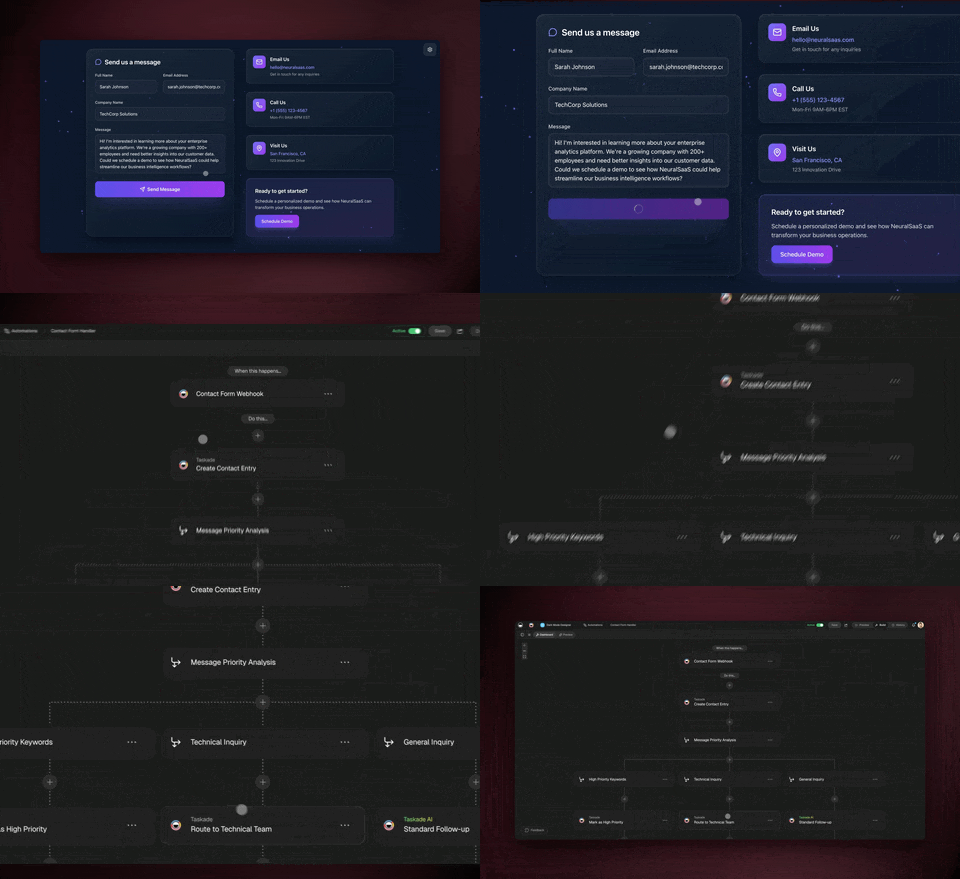
An external event (webhook, form submission, task completion) fires an agent-driven flow.
```mermaid
sequenceDiagram
participant External as External Service
participant Trigger as Taskade Trigger (Webhook / Form / Mail)
participant Flow as Automation Flow
participant Agent as AI Agent
participant Action as Downstream Action
External->>Trigger: Event occurs
Trigger->>Flow: Fire automation
Flow->>Agent: Prompt with event context
Agent->>Flow: Response or decision
Flow->>Action: Execute action with agent output
Action->>External: Side effect
```
### Example: customer feedback triage
1. Webhook trigger receives inbound form submission.
2. Agent classifies sentiment and extracts key topics.
3. Flow routes:
* Negative + urgent → create a support ticket.
* Feature request → append to the feedback project.
* Positive → thank-you email automation.
***
## Pattern: Multi-Agent Team
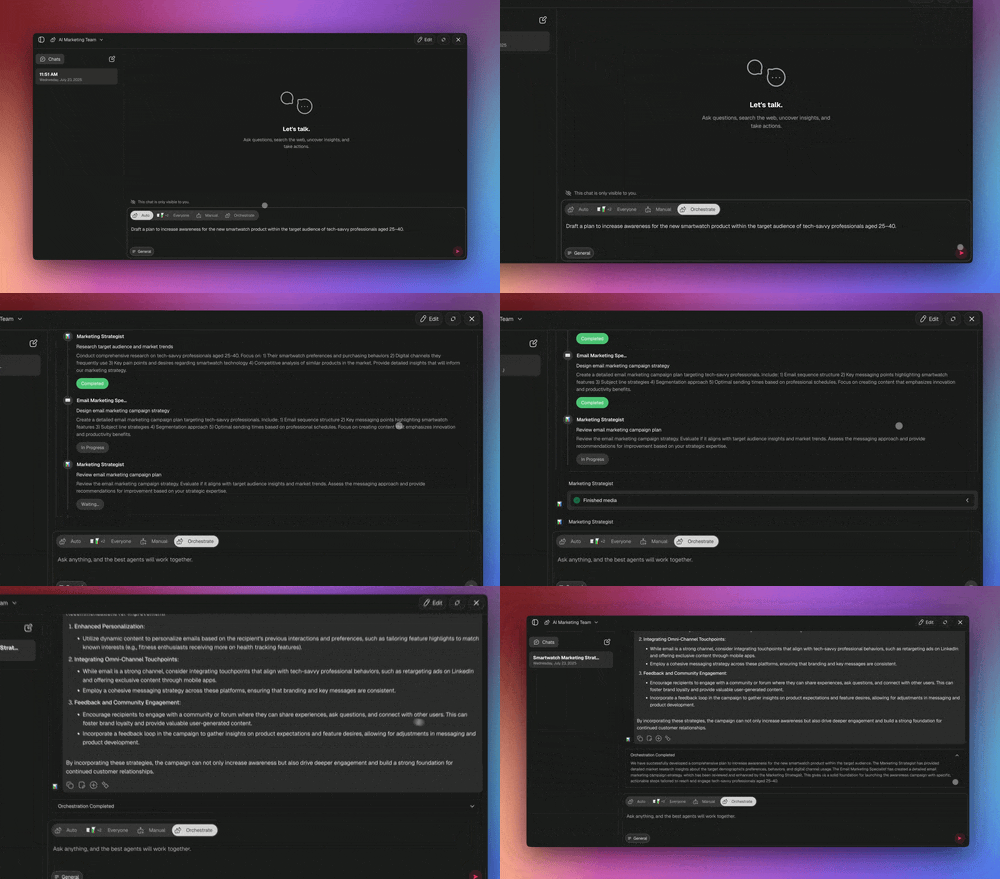
A coordinator agent delegates work to specialist agents. Each specialist has its own knowledge, tools, and persona.
```mermaid
graph TB
User[User prompt] --> Coordinator[Coordinator Agent]
Coordinator --> Researcher[Researcher Agent web search, RSS]
Coordinator --> Writer[Writer Agent drafting tools]
Coordinator --> Editor[Editor Agent style guide]
Researcher --> Coordinator
Writer --> Coordinator
Editor --> Coordinator
Coordinator --> Output[Final output]
```
### Orchestration modes
* **Auto** — Coordinator picks which specialist to delegate to based on the task.
* **Everyone** — Every specialist responds; coordinator synthesizes.
* **Orchestrate** — Coordinator runs a structured handoff plan.
### Programmatic use
```typescript
// Your app prompts the coordinator; the team resolves internally
const res = await fetch("https://www.taskade.com/api/v2/promptAgent", {
method: "POST",
headers: {
Authorization: `Bearer ${process.env.TASKADE_TOKEN}`,
"Content-Type": "application/json",
},
body: JSON.stringify({
spaceId: SPACE_ID,
agentId: COORDINATOR_ID,
prompt: "Produce a blog post on our Q2 launch, ready to publish.",
}),
});
const { summary } = await res.json();
```
***
## Pattern: Self-Invoking Chain
An agent can call **another agent as a tool.** This lets specialist pipelines run without your app orchestrating each step.
```typescript
// Agent A is configured with Agent B as a tool.
// Your app only talks to Agent A.
const res = await fetch("https://www.taskade.com/api/v2/promptAgent", {
method: "POST",
headers: {
Authorization: `Bearer ${process.env.TASKADE_TOKEN}`,
"Content-Type": "application/json",
},
body: JSON.stringify({
spaceId: SPACE_ID,
agentId: AGENT_A_ID,
prompt: "Research the latest on X and draft a blog outline",
}),
});
const { summary } = await res.json();
// Under the hood:
// Agent A (coordinator) → calls Agent B (researcher) as a tool
// Agent B returns findings → Agent A writes the outline
// A single response returns to your app
```
Cross-agent invocation shifts orchestration inside Taskade. Your app stays simple; agents handle the delegation.
***
## Monitoring and Observability
### Per-run details
Every automation run has a **Run Details** tab showing:
* Step-by-step execution log
* Inputs and outputs per step
* Errors with context
* Agent credits consumed
### Usage analytics
* **Per-agent usage analytics** — see which agents consume the most credits
* **Workspace activity log** — credit pack purchases, configuration changes
* **Automation status badges** — quick visual indicator of health
### Errors that don't retry
Taskade's automation engine distinguishes transient from permanent errors.
* **Transient** (timeouts, 5xx) — auto-retried with backoff.
* **Permanent** (invalid credentials, 400 errors) — fail fast, no retry, notification raised.
This prevents runaway credit spend on a broken connection.
***
## Plan Gating
| Feature | Free | Pro | Business+ |
| -------------------------------------- | ------- | ------- | --------- |
| Automations (basic triggers + actions) | Limited | ✓ | ✓ |
| Multi-agent teams | — | Limited | ✓ |
| Cross-agent invocation | — | ✓ | ✓ |
| Autopilot | — | ✓ | ✓ |
| Hosted MCP v2 (outbound connectors) | — | — | ✓ |
{% hint style="info" %}
See [pricing](https://www.taskade.com/pricing) for the authoritative gating per plan.
{% endhint %}
***
## Related
{% content-ref url="/pages/gAVvLQJwpYMggTbXn18Q" %}
[Action API v2 Reference](/developers/api-v2-reference.md)
{% endcontent-ref %}
{% content-ref url="/pages/s8WatfU5B60ugwEJ3tQF" %}
[SDK Cookbook](/developers/sdk-quickstart/sdk-cookbook.md)
{% endcontent-ref %}
{% content-ref url="/pages/mjYJ3rVPZjOpufLeQ9bI" %}
[Long-Term Memory](/developers/long-term-memory.md)
{% endcontent-ref %}
{% content-ref url="/pages/bk6HqQ3xSMuj7nf7lNaY" %}
[Multi-Agent Collaboration](/ai-features/ai-features/multi-agents.md)
{% endcontent-ref %}
{% content-ref url="/pages/qlvEbsdwIpQOibli4ygg" %}
[Autopilot](/ai-features/ai-features/autopilot.md)
{% endcontent-ref %}
{% content-ref url="/pages/lkO0RhPMTu96r9Zg6OHU" %}
[Automations Overview](/automations/automation.md)
{% endcontent-ref %}
---
# Agent Instructions
This documentation is published with GitBook. GitBook is the documentation platform designed so that both humans and AI agents can read, navigate, and reason over technical content effectively. Learn more at gitbook.com.
## Querying This Documentation
If you need additional information that is not directly available in this page, you can query the documentation dynamically by asking a question.
Perform an HTTP GET request on the current page URL with the `ask` query parameter, and the optional `goal` query parameter:
```
GET https://docs.taskade.com/developers/autonomous-agents.md?ask=&goal=
```
`ask` is the immediate question: it should be specific, self-contained, and written in natural language.
`goal` is optional and describes the broader end goal you are ultimately trying to accomplish on behalf of the user. GitBook uses it to tailor the answer towards what is most useful for that goal.
The response will contain a direct answer to the question and relevant excerpts and sources from the documentation.
Use this mechanism when the answer is not explicitly present in the current page, you need clarification or additional context, or you want to retrieve related documentation sections.